EMDR Therapy in Wyndmoor, PA
- Jan 18
- 4 min read
Updated: Apr 10
EMDR is a therapy for processing traumatic or distressing experiences using bilateral stimulation (BLS) such as bilateral eye movements, tapping, or sound. EMDR therapy could support you if you feel stuck, like your body and nervous system just won’t catch up with what your logical brain knows to be true. EMDR forms the foundation of how I approach therapeutic work and my philosophy on what it takes to heal.
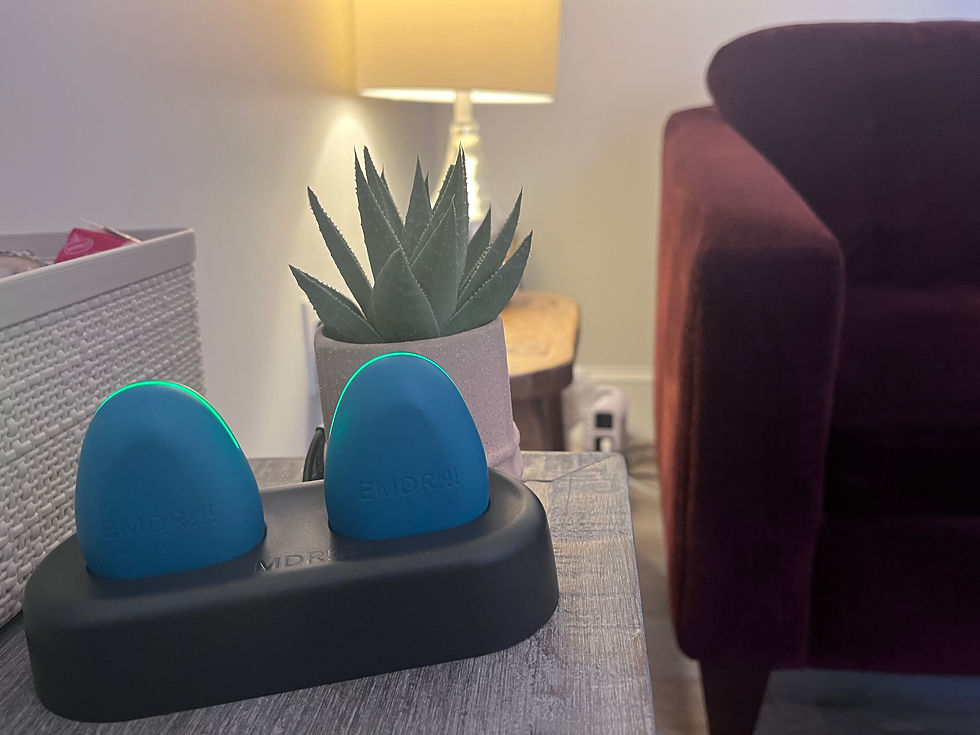
What is EMDR?
Eye-Movement Desensitization and Reprocessing (EMDR) is a trauma therapy proven to help people recover from PTSD, Complex trauma, and more. EMDR was developed in response to the discovery that eye movements, similar to what happens in REM sleep, can support trauma healing. Bilateral stimulation (BLS) such as eye movements, tapping, or auditory cues, help to stimulate the right and left hemispheres of the brain. This stimulation can help us reprocess experiences in life. We use BLS with specific memories and associated beliefs, imagery, emotions, and physical sensations.
EMDR can be nicely integrated into other therapeutic modalities, including traditional talk therapy.
What do EMDR therapy sessions look like?
EMDR is made up of eight phases. These phases are not entirely linear and the process is collaborative. We decide together what makes most sense for any given session on any given day.
Phase 1: History Taking
In this phase, we get to know one another, and explore enough of your history to do good trauma work together.
Phase 2: Resourcing
We develop a toolbox of tools, strategies, resources that are specific to your needs and daily stressors. These resources can be cognitive, somatic, behavioral, or imagery-based, among many others.
Phase 3: Assessment
We select a target experience or memory to work with and identify the main components of the memory without going into too much detail.
Assessment includes identifying an aspect of the memory - often, but not always, an image - that stands out. That image is paired with an associated negative belief, a desired positive belief, an associated emotion, and an associated physical sensation.
Phase 4: Desensitization
We “desensitize”, or reduce the charge on the most challenging parts of the memory so it feels less distressing when it appears in your conscious or unconscious awareness.
To support with desensitization, we’ll use bilateral stimulation, such as eye movements, tapping, buzzers, or auditory cues.
Phase 5: Installation
In the space that now exists, we install a more supportive and positive belief.
Phase 6: Body Scan
Once we’ve installed a more positive belief, we scan the body briefly to notice if there’s any residual distress that lingers when the memory is slightly activated. If distress still lingers, we process that until that’s cleared.
Phase 7: Closure
If we’re complete with the memory, we close it out and discuss next steps. If the memory re-processing is incomplete, we find a safe enough place to pause and leave enough time to resource so that you leave feeling grounded.
Phase 8: Re-Evaluation
We check in between sessions to notice any shifts or insights. If we ended the previous session with an incomplete memory, we decide to return to it or engage with something else for the time being. If we ended the previous session with a complete memory, we collaborate on which direction to turn next.
How can EMDR therapy help me?
Sometimes when we experience trauma, our brains, bodies, and nervous systems naturally heal. Other times, trauma seems to get stuck in our brains, bodies, and nervous systems. When this happens, we experience dysregulation in the present day. The stuck trauma impacts thoughts, beliefs, emotion regulation, and even physical sensations in the body.
EMDR can help to reprocess these memories to help them get unstuck. This works because BLS is thought to help unlock the stuck memories so that they can be processed more adaptively by integrating right and left hemispheres. EMDR also supports “dual-awareness”, or the idea that we keep one foot in the present, while we dip one toe into the past. Dual-awareness helps to prevent reliving and re-experiencing as we process.
For complex trauma, EMDR can work just the same. We may take slightly different approaches when there isn’t just one single memory to target. For example, many folks ask, “What if I don’t remember? It’s just a feeling.” We can still work with that!
How do you utilize EMDR?
I utilize EMDR even when we’re not explicitly using bilateral stimulation and it doesn’t feel like we are doing EMDR.
EMDR is based on a model called the Adaptive Information Processing Model. I use this model throughout all my work. I am always curious about how a person’s earlier experiences in life - more recent and more distant - possibly impact their present day experiences.
What are your EMDR credentials?
I completed my basic training in EMDR and am continuing to receive consultation and continuing education. Below are some trainings I’ve completed in EMDR
EMDR for Complex Trauma
EMDR for Grief and Loss
EMDR for Pregnancy
EMDR for Sexual Health
EMDR for Pre-Verbal Trauma
Four Blinks, a modification to EMDR for reprocessing with little distress in a quick amount of time
Ready to get started with EMDR?
I offer in-person EMDR therapy in Wyndmoor, PA which is near Chestnut Hill and Greater Philadelphia, Glenside, Lafayette Hill, Plymouth Meeting, and Flourtown. I also offer virtual EMDR therapy in Pennsylvania and Ohio. Reach out to me at abby@abbyalbrightlpc.com or submit a contact request so we can set up a consultation.